 Solora
What is the Big 3 method?
The Big 3 is a daily focus rule: out of everything you could do today, you name three things that matter most and you protect them. It isn't your whole to-do list. It's the short list that decides whether today was a good day.
The idea is old and has a few cousins. Leo Babauta's “Most Important Tasks” are three things you must accomplish, done first thing in the morning. The Ivy Lee method, from 1918, asks for six tasks, written the evening before and done strictly in order. “Big 3” is simply a common name for the three-item version.
What makes it work is not the number. It's the decision. A long list lets you stay busy without choosing; a list of three forces you to say “this, not that”.
Why three? And when are 1 or 5 better?
Three is small enough to finish on a messy day and big enough to feel like progress. Use 1 when one task is genuinely huge or your energy is low; use 5 only when the items are small and quick.
| Number | Good for | Watch out for |
|---|---|---|
| 1 | Deep-work days, deadlines, sick or low-energy days, days full of meetings | Picking something so big it can't finish today |
| 3 | Most days: one big outcome plus two smaller ones, often from different roles | Sneaking a fourth and fifth item in “just in case” |
| 5 | Admin days with many small, clear tasks | Five big tasks: that's a to-do list, not a focus list |
A useful test: if your Big 3 regularly takes the whole day, the items are too big. They should fit inside your real free time, after meetings, school runs and dinner.
How do I pick my Big 3 in two minutes?
Look at your list, ask “if only three things happened today, which would make it a good day?”, and rewrite each answer as an outcome with a clear finish line. That's it. Here's the slightly longer version.
- Glance, don't plan.
Open your list or your head. Thirty seconds. You're not organizing everything, you're choosing.
- Ask the good-day question.
“If I only did three things today, which three would I be glad about tonight?” Urgent-and-important first; one thing that moves a bigger goal second.
- Make each one finishable.
Replace verbs like “work on” and “look into” with a result you could tick off: “Book the dentist”, “Send section 2 to Deniz”, “Run 20 minutes”.
- Check the size.
Could all three fit in the time you actually have? If not, shrink one (“Outline the talk” instead of “Write the talk”).
- Check the roles.
Are all three for the same part of your life? Fine sometimes. If it's been that way all week, swap one for the role that's been waiting.
| Vague (hard to finish) | Big 3 (clear finish line) |
|---|---|
| Work on the report | Send the draft of section 2 for review |
| Exercise more | 20-minute walk after lunch |
| Sort out finances | Cancel the two subscriptions I don't use |
| Spend time with the kids | Bedtime story, phone in another room |
| Study for the exam | Do practice questions 1–20 for chapter 4 |
How do I stop one role eating my whole day?
Pick your Big 3 from different roles when the week needs it. If work has taken all three slots for four days running, tomorrow's third slot goes to the role that's been waiting: family, health, a side project, yourself.
This is what I call Big 3 by Role. It's not about perfect balance every day. Launch weeks and exam weeks are lopsided, and that's fine. It's about not letting lopsided become the default without noticing. The easiest way to notice is a short weekly look at what each role actually got, which is the heart of role-based planning and the 15-minute weekly review.
A simple rule of thumb:
- Slot 1: the most important outcome, whatever role it belongs to.
- Slot 2: something that moves a bigger goal forward.
- Slot 3: the role that's been quiet this week.
On a normal day that might be one work task, one health habit and one family moment. On a deadline day it might be work, work and a 10-minute walk. Both are fine. You decided.
What happens to the Big 3 items I don't finish?
Move them on purpose. Each unfinished item gets one of four decisions: carry it to tomorrow, make it smaller, give it a specific later day, or drop it. What you shouldn't do is let it silently fall back into the big list.
- Carry over when it still matters and just didn't fit.
- Make it smaller when it was too big: “Write the proposal” becomes “Write the first paragraph”.
- Reschedule when you're waiting on someone or something.
- Drop it when you realize it isn't important any more. That's a decision, not a failure.
The three-strike rule. If the same item has carried over three days in a row, stop carrying it. It's either too big (split it) or not really a priority (drop it or schedule it for next week). Carrying it a fourth time just adds guilt.
Try it in Solora
A short list you can actually finish, every day
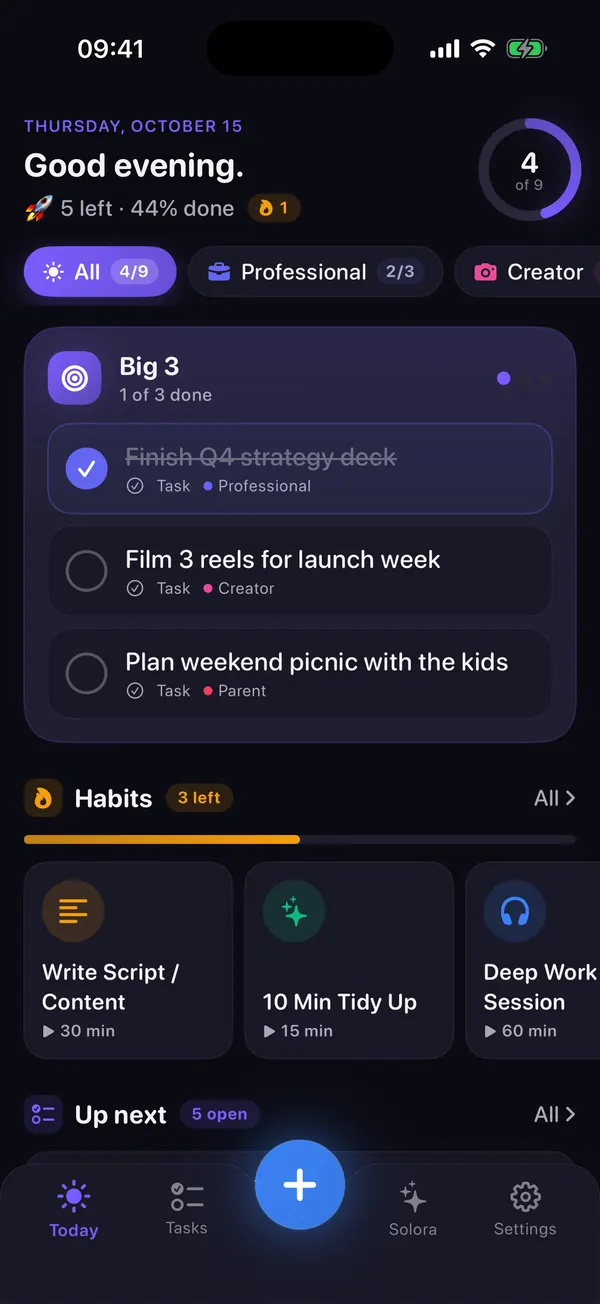
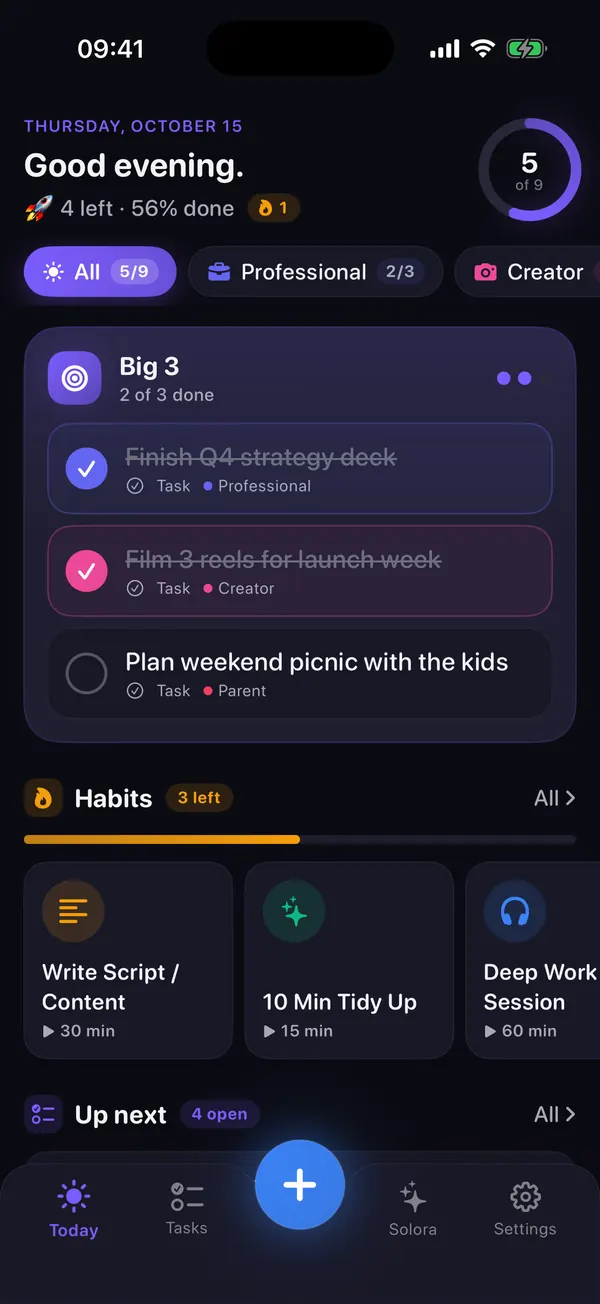
Solora: AI Life Planner keeps your Big 3 front and center on the Today screen and handles the leftovers for you.
- Choose 1, 3 or 5 daily priorities when you set up the app.
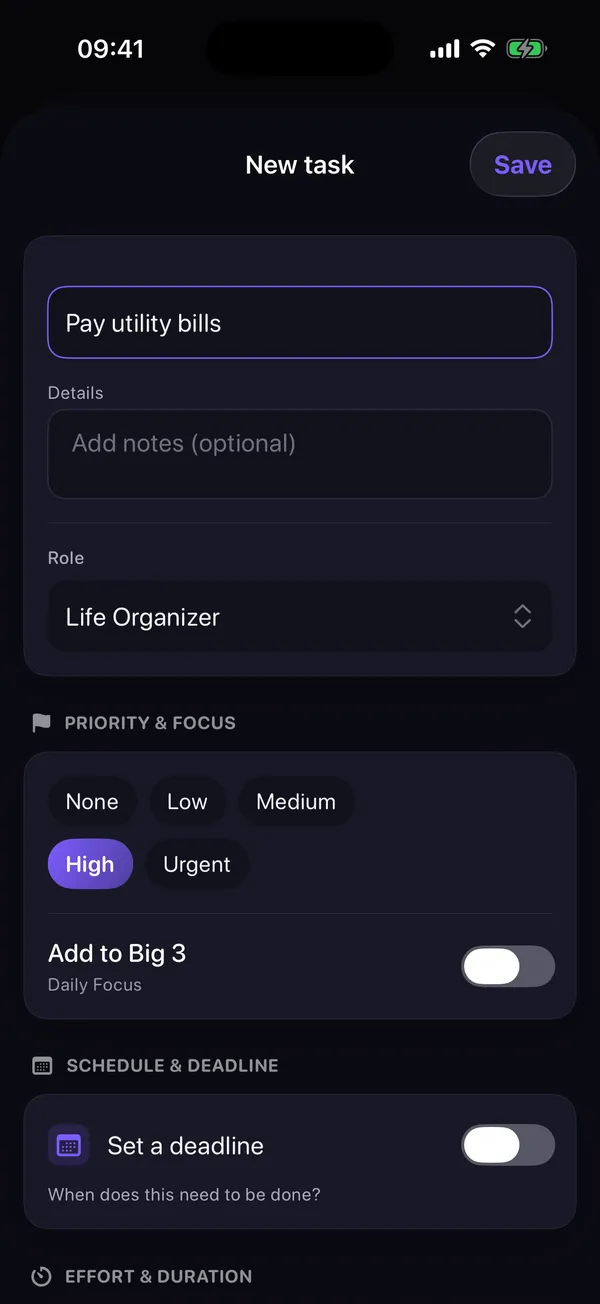
- Add tasks, habits, projects or project steps to today's focus with one tap.
- Unfinished items carry over to tomorrow, marked “Carried over”; overdue tasks keep a “Late” tag instead of vanishing.
- When something slips (an overdue task, or anything still open at your Evening Shutdown), choose “I couldn't do this”: Solora asks what got in the way, then helps you move it, split it, make it easier or let it go.
 On your computer?Scan with your iPhone camera
Free on iPhone and iPad (iOS 18.6+), no account. The free plan covers up to 15 active tasks and 4 roles.
Big 3 vs MIT vs 1-3-5 vs Ivy Lee vs Eisenhower: which should I use?
Use the Eisenhower matrix to sort a big backlog, the 1-3-5 rule when your days are full of small tasks, Ivy Lee when you like a strict order, and the Big 3 when you need to focus on a few outcomes. Many people sort weekly and focus daily.
| Method | How many | When you choose | Best for | Watch out for |
|---|---|---|---|---|
| Big 3 | 3 outcomes (or 1 or 5) | The evening before or first thing | Busy lives with several roles | Items that are too big to finish |
| MITs (Most Important Tasks) | 3 tasks | Morning, done first | Making daily progress on goals | Mornings you don't control |
| 1-3-5 rule | 1 big, 3 medium, 5 small | Start of the day | Jobs with lots of small requests | Nine items can still feel like a list |
| Ivy Lee method | 6 tasks, in strict order | End of the previous day | People who like single-tasking | Six is a lot on a busy day |
| Eisenhower matrix | No fixed number | Whenever you sort the backlog | Separating urgent from important | It sorts, but doesn't pick today's focus |
Sources for the methods: Zen Habits on MITs, The Muse on the 1-3-5 rule, James Clear on the Ivy Lee method, and FranklinCovey on urgent vs important.
They combine well. A practical setup: once a week, sort your list by urgent and important; every day, pick your Big 3 from the important column.
What does a good Big 3 look like? Four examples
A good Big 3 is specific, finishable today, and usually touches more than one part of your life. Here are four real-life shapes.
| Who | 1 | 2 | 3 |
|---|---|---|---|
| Student | Practice questions 1–20, chapter 4 (Student) | Email the group about Thursday's slides (Student) | 30-minute gym session (Athlete) |
| Working parent | Send the client proposal (Professional) | Book the school meeting (Parent) | Walk at lunch, no phone (Wellness) |
| Creator | Film three short clips for Friday (Creator) | Reply to the brand email (Entrepreneur) | Call Mum (Family member) |
| Founder | Ship the pricing page fix (Entrepreneur) | Prep Monday's investor update (Leader) | Dinner with my partner, laptop closed (Partner) |
Notice the third column. That's usually the slot that disappears first when you don't name it. If you're a creator, the creator toolkit has more on keeping posting consistent without burning out.
Big 3 method FAQ
Is the Big 3 the same as MITs (Most Important Tasks)?
Almost. Both pick three important things a day. MITs, as Leo Babauta describes them, are done first thing in the morning and at least one should relate to a goal. The Big 3 is often chosen the evening before and focuses on outcomes, but the core idea is the same: decide a few things, then protect them.
Should I choose my Big 3 the night before or in the morning?
Either works; pick the one you'll actually do. The evening before is calmer and lets you start straight away. The morning lets you match the plan to how you feel. Many people sketch it at night and adjust it in a 2-minute morning check.
What if something urgent comes up?
Swap, don't add. If a real emergency takes a slot, one of your three moves to tomorrow. Keeping the list at three is what keeps it honest. In Solora, if today's focus is full and you add something, it asks you to swap one item out.
Can habits be part of my Big 3?
Yes, if a habit is what would make today a good day, like a run before a race or a study session before an exam. In Solora, Big 3 items can be tasks, habits, projects or individual project steps.
What if I finish my Big 3 by lunchtime?
Great day. Take a short break, then work from your normal list without adding pressure. Don't promote a fourth “Big” item; the point of the method is that three done is already a win.
Your whole life. One focused day.
Pick today's Big 3 in under two minutes
Solora sets up your roles and your daily focus in about five minutes, then carries over whatever you don't finish. No account, and the AI assistant runs on your device.
On your computer?Scan with your iPhone cameraFree to download, with optional Premium (monthly, yearly or one-time Lifetime); see the current price on the App Store. See what's free.
Sources
- Leo Babauta on Most Important Tasks (MITs), Zen Habits: zenhabits.net
- James Clear on the Ivy Lee method: jamesclear.com/ivy-lee
- The Muse Editors, “A Better To-Do List: The 1-3-5 Rule”: themuse.com
- FranklinCovey, “Habit 3: Put First Things First”: franklincovey.com
- Solora features checked against the shipped app (version 3.0) on 15 October 2026.